Growth is almost always applauded.
More clients. More revenue. A bigger team.
From the outside, fast growth looks like momentum and success.
Inside the business, though, it often feels very different.
Decisions pile up. Pressure increases. Teams stretch themselves thinner. Leadership stays deeply involved just to keep things moving. What looks exciting from the outside can feel unstable on the inside.
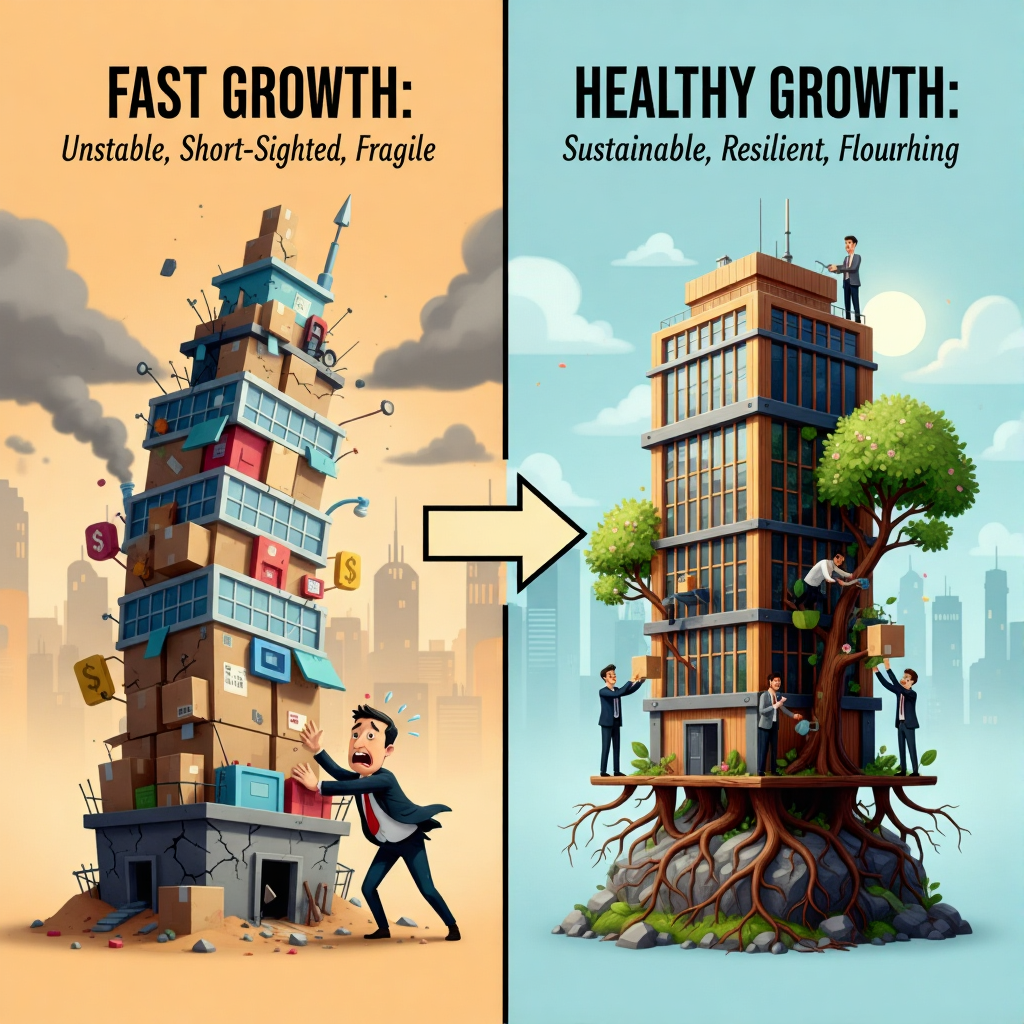
This is where many businesses go wrong. They chase speed without asking a harder question: Is this growth actually healthy?
Because fast growth and healthy growth are not the same thing and confusing them can quietly damage an otherwise strong business.
Why Fast Growth Feels So Right
Fast growth is rewarding. It validates the idea, the effort, the risk. It proves the market is responding.
Typically, fast growth shows up as:
- A sudden increase in sales or demand
- Quick hiring to “keep up”
- Expansion driven by opportunity, not preparation
There’s nothing wrong with momentum. Problems start when speed becomes the default decision-maker.
When everything is urgent, foundations are rarely questioned.
What Fast Growth Often Overlooks
In fast-growing businesses, systems are usually built in reaction mode.
Processes evolve informally. Roles overlap. Decisions stay close to leadership because that feels faster. Short-term solutions replace long-term design.
For a while, it works.
But under the surface, operational gaps begin to form:
- Too much depends on specific people
- Knowledge lives in conversations, not systems
- Quality control relies on effort instead of process
The business grows, but its ability to handle growth does not grow at the same pace.
Eventually, speed exposes what structure hasn’t caught up to.
What Healthy Business Growth Looks Like?
Healthy growth is less dramatic, but far more stable.
It’s built on:
- Processes that work even when people change
- Teams that understand priorities clearly
- Decision-making that doesn’t bottleneck at the top
- Systems designed for scale, not survival
In a healthy growth environment, challenges still exist—but they feel manageable. Growth adds confidence instead of anxiety.
This is what sustainable business growth actually looks like in practice.
Fast Growth vs Sustainable Growth
Fast growth focuses on momentum.
Healthy growth focuses on capacity.
The difference becomes clear over time.
Fast-growing businesses often say, “We’ll fix this later.”
Healthy businesses ask, “Will this still work when we double?”
That shift in thinking changes everything from hiring decisions to process design to leadership involvement.
Sustainable growth isn’t slower by default. It’s simply intentional.
Leadership’s Role in Growth
In fast growth phases, leaders often become more operational.
They approve more. They intervene more. They solve problems directly to keep things moving.
In healthy growth phases, leadership evolves.
The focus shifts toward:
- Designing scalable systems
- Clarifying decision authority
- Building accountability frameworks
Strong leadership is not about doing more. It’s about building a business that doesn’t depend on constant oversight.
That transition is critical for long-term growth.
How Teams Experience the Difference
Teams feel the impact of growth long before leadership sees it on reports.
In fast growth environments, teams often deal with:
- Constant urgency
- Changing expectations
- Unclear ownership
People work hard, but stability is missing.
In healthy growth environments:
- Roles are clear
- Processes are predictable
- Pressure exists without chaos
Operational efficiency improves not because people work harder, but because work makes more sense.
Why Fast Growth Eventually Slows Down
Fast growth often creates internal strain that shows up later as:
- Slower decision-making
- Declining quality
- Leadership fatigue
- Customer experience issues
At this stage, businesses often blame the market or competition. In reality, growth has simply outpaced internal structure.
Without addressing these gaps, scaling becomes harder, not easier.
Making the Shift to Healthy Growth
Most successful companies experience fast growth at some stage. That’s normal.
What matters is recognizing when speed needs to be supported by structure.
That usually means:
- Stepping back to assess systems
- Identifying operational gaps
- Redesigning processes for scalability
- Reducing dependency on individuals
This is where tools like business gap analysis play a quiet but powerful role—helping leaders see what needs to evolve before problems become expensive.
What Healthy Growth Protects
Healthy growth protects more than revenue.
It protects:
- Leadership clarity
- Team morale
- Brand consistency
- Customer trust
- Long-term profitability
It allows the business to grow without sacrificing control or culture.
A Simple Question That Reveals the Truth
Ask yourself this:
Does growth make the business feel stronger or more fragile?
If growth increases clarity, alignment, and confidence, it’s healthy.
If growth increases stress, dependency, and confusion, speed is outrunning structure.
That distinction matters more than numbers on a dashboard.
Final Perspective
Growth is not just about moving faster.
It’s about holding the business together while it expands.
Fast growth may look impressive.
Healthy growth is what keeps the business standing years later.
The strongest businesses don’t reject speed.
They support it with systems, clarity, and design.